Does Your Body Really Have a Set Weight? The Science Behind Set Points, Plateaus and Weight Regain
You lose weight. Things are going beautifully. Then the scales stop moving. A week passes. Then another.
Or perhaps you've lost a significant amount of weight, you're considering coming off a GLP-1 medication, and suddenly your Facebook feed serves up something along the lines of:
Your body has a set point and if you lose weight below it, your body will fight to get back there.
If you've spent years trying to lose weight — particularly through perimenopause and menopause — it's very easy to read something like that and wonder whether your body has somehow selected a number and intends to drag you back there regardless of what you do.
So, do we really have a “set weight”?
The answer is considerably more interesting than some 'experts' on social media would have you believe.
What is the set-point theory?
The idea of a body-weight “set point” has been around for decades. It's not some new phenomenon.
In its simplest form, the theory proposes that our bodies have biological systems that regulate body fat and weight around a preferred level, rather like a thermostat regulating the temperature of a room.
Move too far away from that level and various biological responses may kick in to encourage the body back towards it.
There is certainly evidence that body weight is biologically regulated. We have complex systems involving the brain, gut, adipose tissue, hormones and energy expenditure that influence hunger, satiety and how much energy we use.
But this is where the social-media version gets ahead of the science.
Researchers still don't agree that humans have one fixed body-weight set point.
A major 2023 review by researchers John Speakman and Kevin Hall described several different scientific models of body-weight regulation, including set-point, settling-point, dynamic equilibrium and dual-intervention-point models.
Their conclusion? We still need considerably more research to determine which models best explain human weight regulation.
In other words, science has not discovered a little dial inside you labelled “Jane: 62kg. DO NOT ALTER.”
So what is a “settling-point”?
This is where I find the conversation much more useful.
Rather than imagining one genetically predetermined weight that your body will defend forever, the settling-point model considers body weight as the result of interactions between our biology and our environment.
That can include our genetics, appetite, food environment, eating patterns, physical activity, muscle mass, sleep, medications, stress and countless other factors.
Change some of those inputs and the weight at which your body settles may also change.
It helps explain why asking, “What is my set point?” isn't particularly useful.
We don't have a clinical test that can identify your personal “set point”, and a previous weight isn't proof that your body is biologically programmed to return there.
But doesn't the body fight weight loss?
This is where the set-point conversation contains an important nugget of science.
When we lose weight, particularly through significant energy restriction, the body can respond. One response is called adaptive thermogenesis, sometimes referred to as metabolic adaptation.
As your body becomes smaller, you'd expect it to require less energy simply because there's less body to maintain and move around. But in some people, energy expenditure can fall somewhat more than we'd predict from the change in body size and composition alone.
That phenomenon is real.
However, its size and importance are often exaggerated online.
A 2022 systematic review examined 33 studies involving more than 2,500 adults. Adaptive thermogenesis was detected in many of the studies, but there was considerable variation between individuals and studies.
Importantly, better-designed studies tended to find smaller or non-significant effects, and metabolic adaptation appeared to become smaller — or sometimes disappear — following periods of weight stabilisation.
So no, dieting hasn't necessarily “broken your metabolism”. And metabolic adaptation isn't evidence that your body has decided you're supposed to weigh a certain weight.
Hunger matters too
Energy expenditure is only one side of this. Our appetite-regulating systems can also respond to weight loss.
A well-known study published in the New England Journal of Medicine followed people after significant diet-induced weight loss.
Researchers found changes in several hormones involved in appetite regulation, including leptin and ghrelin, along with increased subjective hunger. Some of these changes were still evident a year after the initial weight loss.
That matters.
Because if you've lost a significant amount of weight and subsequently notice you're hungrier or more interested in food, it doesn't necessarily mean you've suddenly lost your willpower. There may be biology contributing to it.
But — and this is an important BUT — increased hunger is not proof that you've dropped below your body's “set point”.
It's evidence that human appetite and body-weight regulation are complicated.
Welcome to the human body. It doesn't do simple.
Does a weight-loss plateau mean you've reached your set point?
Short answer - no.
If your weight has hovered around the same number for three or four weeks, you cannot conclude that this must be the 'ideal' weight your body intends to defend forever.
Weight loss is rarely linear.
As body weight decreases, energy requirements change. Food intake can creep up without us noticing. Movement can change. Training can affect body composition. Glycogen, bowel contents and fluid fluctuate. Menstrual cycles can affect scale weight in women who are still cycling.
And sometimes the scales simply don't move for a while.
A plateau is information.
What about menopause?
For women in midlife, we need another layer in this conversation because changes during the menopause transition can affect body composition even when the scales aren't doing anything particularly spectacular.
Longitudinal data from the Study of Women's Health Across the Nation (SWAN) found that during the menopause transition the rate of fat gain increased while lean mass declined.
Interestingly, the researchers didn't find a corresponding menopause-related acceleration in total body-weight gain.
Read that again (please).
Body composition was changing even when total body weight didn't necessarily reflect what was happening.
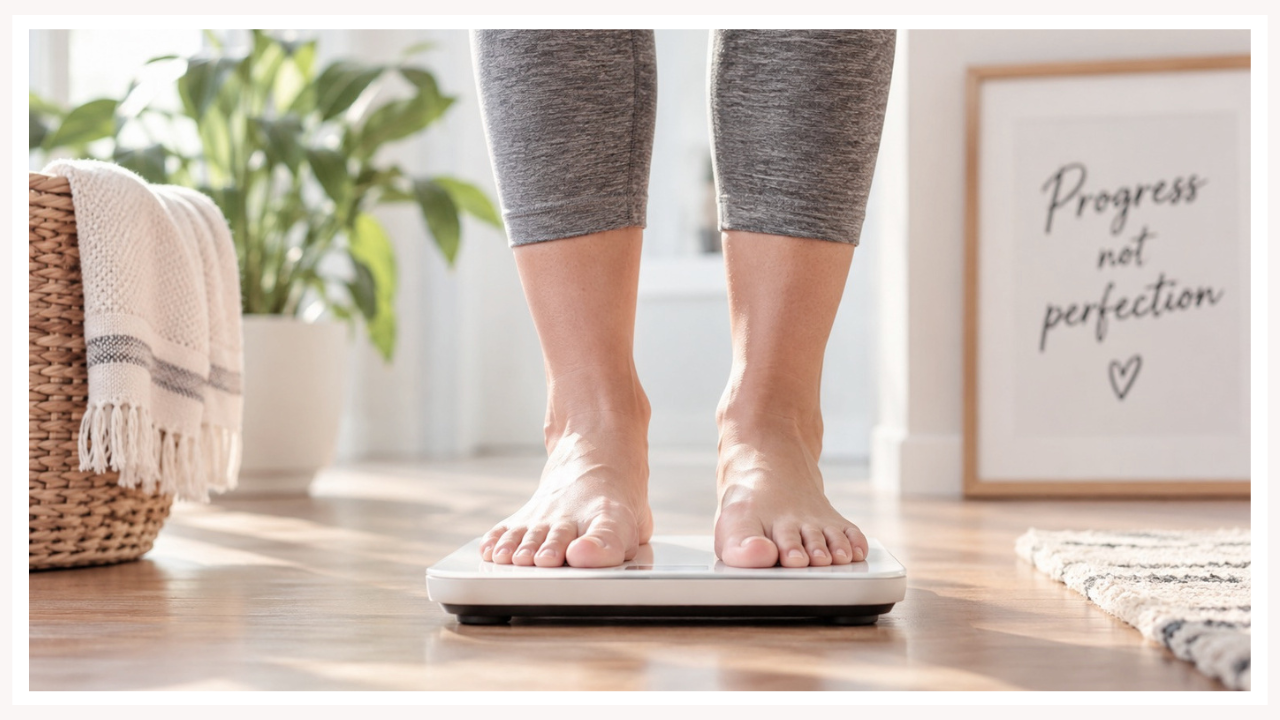
This is one of the reasons I'm forever telling women not to give the bathroom scales a job they're totally unqualified to perform.
It tells you exactly what it's designed to measure — your total body weight at that particular moment.
It simply doesn't tell you all the information.
It can't tell you how much of that weight is fat versus lean tissue. It can't tell you whether you've become stronger, whether your waist circumference has changed, whether you've improved your bone health, whether your clothes fit differently or whether you can now haul your suitcase into the overhead locker without requiring assistance from a 22-year-old flight attendant.
The number matters.
BUT (and a big BUT), it's just one piece of data.
Now let's talk about GLP-1s
This is where set-point theory gets particularly interesting — and where some very sweeping claims are being made online.
GLP-1-based medications influence appetite, satiety and food intake. When that effect is removed, it shouldn't surprise us that appetite and weight can change again.
And we have evidence that weight regain after stopping treatment is common.
In the STEP 1 extension study, participants who had received semaglutide 2.4mg lost an average of 17.3% of their body weight during treatment.
One year after treatment was withdrawn, they had regained an average of 11.6 percentage points — roughly two-thirds of their previous weight loss.
That result understandably gets a LOT of attention.
But there's another part that often gets left out of the sensationalised media version.
At the end of that follow-up period, participants were still, on average, 5.6% below their original body weight.
So the study did not demonstrate that everybody's body simply marched straight back to a predetermined starting weight. It demonstrated that substantial weight regain was common after treatment stopped.
Those aren't quite the same statement.
And now we have newer evidence
In January 2026, The BMJ published a systematic review and meta-analysis examining what happened after people stopped weight-management medications.
This wasn't a tiny study. Researchers reviewed 37 studies involving 9,341 participants.
Across the studies, weight regain after medication cessation averaged approximately 0.4kg per month. The researchers estimated that, if that trajectory continued, average weight could return towards baseline in approximately 1.7 years.
They also found that regain following weight-management medications was faster than following behavioural weight-management programmes.
That's important evidence and we shouldn't sugar-coat it.
But again, these are group averages.
They don't tell us exactly what will happen to one individual woman. And they don't prove that regain occurs because the body has one predetermined “set point”.
What they do tell us is that obesity and weight regulation involve powerful biological processes, and that for many people GLP-1 treatment may need to be considered long-term rather than as a short course of medication followed by “job done”.
Whether someone continues, reduces or stops their medication is a conversation to have with their prescribing clinician.
So if you stop a GLP-1, are you doomed to regain the weight?
No.
But nor would I tell you that eating well and exercising guarantees you won't regain weight. That's not what the evidence says either.
And this is where I get a little concerned when I see people suggesting that if you just “build good habits” while you're taking the medication, you'll be fine afterwards.
Habits matter enormously. 100%.
But habits don't magically switch off biology.
This isn't a morality play in which the person who meal-prepped chicken and broccoli and went to the gym 5 days a week gets to keep the weight off while everyone else simply didn't try hard enough.
For some people, ongoing pharmacological treatment may form part of long-term weight management. For others, medication may be reduced or stopped under medical supervision.
And this is an area where we're going to learn a great deal more over the next few years.
Can you “reset” your set point?
You'll see claims online that maintaining a lower weight for a particular period — often one, two or three years — will “reset” your set point. I'd be cautious with that language.
There isn't good evidence that we can nominate a specific length of time after which the body accepts a new weight and resets some internal thermostat.
There is evidence that some metabolic adaptations can become less pronounced following weight stabilisation.
That's interesting and potentially reassuring. It isn't the same as proving that your set point has been permanently reset.
Science is allowed to say “we don't know yet.” I wish social media would occasionally give it a go.
So what CAN you influence?
Quite a lot.
And this is where I want the conversation to move away from trying to identify a mythical number and towards protecting the body you're living in.
Strength training
During weight loss, we don't only risk losing body fat. Lean tissue can be lost too.
A 2025 review of 25 randomised trials found that adding resistance exercise to dietary weight loss helped protect fat-free mass, increased fat loss and improved muscular strength compared with diet alone.
Interestingly, resistance training didn't produce significantly greater body-weight loss. Which is another lovely reminder that the scales don't get the final vote.
Particularly for women in midlife — and particularly for women losing substantial amounts of weight on GLP-1 medications — maintaining muscle and strength deserves a seat very close to the front of the bus.
Eat enough protein
Protein isn't magic either, but it gives your body the amino acids required to maintain and repair muscle tissue.
A 2024 analysis of 47 studies involving more than 3,200 adults with overweight or obesity found that higher protein intake during weight loss helped preserve muscle mass.
Protein becomes even more important when appetite is low and you're eating considerably less food.
This is why “I'm barely eating — isn't that great?” makes every nutritionist within a 10-kilometre radius develop an eye twitch.
Don't ignore your overall nutrition
A GLP-1 can make eating less considerably easier.
But less food isn't automatically better nutrition.
If intake becomes so low that you're struggling to meet your protein, fibre, micronutrient and energy needs, the goal shouldn't be to celebrate how little you're managing to eat.
We want fat loss while protecting muscle, bone, function and health.
The smallest possible number on the scales isn't the prize.
Keep moving
Walking, incidental movement, cardiovascular exercise and resistance training all have roles to play.
Exercise may not create spectacular scale changes on its own, but its benefits extend well beyond body weight — including cardiovascular fitness, metabolic health, strength, physical function and body composition.
And being able to get yourself off the floor at 75 beats fitting into a pair of jeans you wore in 1994.
Preferably we can have both, but personally, I'm choosing the floor.
Maybe we're asking the wrong question
When someone asks: “What's my set point?”
I understand why.
We want certainty.
We want to know whether the weight we're aiming for is realistic. We want reassurance that our body isn't secretly working against us. And after losing a significant amount of weight, we desperately don't want to hear that we're destined to put it all back on.
But science can't give you a personal set-point number.
So perhaps a better question is:
What weight and body composition can I maintain while eating adequately, staying strong, moving my body, supporting my health and still having a life?
Because maintaining a particular number while permanently hungry, under-eating, losing muscle and organising your entire existence around food isn't much of a victory.
Your body isn't an enemy that needs to be defeated.
And it isn't a calculator with a secret number programmed into it either.
Body-weight regulation is biological, behavioural and environmental. Genetics matter. Appetite matters. Medication matters. Muscle matters. Menopause matters. Your surroundings and habits matter.
There isn't one lever.
And there certainly isn't one number that someone on Facebook can tell you your body has decided you must weigh.
So if the scales haven't moved for a few weeks?
Gather the information. Look at the bigger picture. Adjust things if they need adjusting. But don't assume your body has spoken and the number currently showing on the scale has been assigned to you for eternity.
References
Speakman JR, Hall KD. Models of body weight and fatness regulation. Philosophical Transactions of the Royal Society B. 2023.
A detailed review of competing theories of body-weight regulation, including set-point, settling-point, dynamic equilibrium and dual-intervention-point models.
Nunes CL, et al. Does adaptive thermogenesis occur after weight loss in adults? A systematic review. British Journal of Nutrition. 2022;127(3):451–469.
Systematic review of 33 studies examining metabolic adaptation following weight loss.
Sumithran P, et al. Long-term persistence of hormonal adaptations to weight loss. New England Journal of Medicine. 2011;365:1597–1604.
Study examining appetite and appetite-regulating hormones following significant diet-induced weight loss.
Greendale GA, et al. Changes in body composition and weight during the menopause transition. JCI Insight. 2019.
Longitudinal SWAN data examining changes in fat mass, lean mass and body weight across the menopause transition.
Wilding JPH, et al. Weight regain and cardiometabolic effects after withdrawal of semaglutide: The STEP 1 trial extension. Diabetes, Obesity and Metabolism. 2022;24:1553–1564.
Follow-up of participants after withdrawal of semaglutide 2.4 mg.
West S, et al. Weight regain after cessation of medication for weight management: systematic review and meta-analysis. BMJ. 2026;392.
Systematic review and meta-analysis of 37 studies and 9,341 participants examining weight regain after weight-management medication cessation.
Binmahfoz A, et al. Effect of resistance exercise on body composition, muscle strength and cardiometabolic health during dietary weight loss in people living with overweight or obesity: a systematic review and meta-analysis. BMJ Open Sport & Exercise Medicine. 2025.
Review of randomised trials examining resistance training during dietary weight loss.
Ueshima J, et al. Enhanced protein intake on maintaining muscle mass, strength, and physical function in adults with overweight/obesity: a systematic review and meta-analysis. Clinical Nutrition ESPEN. 2024.
Systematic review and meta-analysis examining protein intake and preservation of muscle during weight loss.
This article provides general education and isn't individual medical advice. If you're taking a GLP-1 or considering changing or stopping your medication, discuss this with your prescribing clinician.
DOWNLOAD YOUR FREE
MIDLIFE RESET GUIDE
Part pep talk, part power move—your midlife guide to ruling the chaos with grit, grace, and a side of snark.
I hate spam more than I hate bad hair days. Your info’s safe with me—I promise.