Your muscles and your gut are talking. And midlife women should be listening.
Why building muscle after 40 involves more than lifting weights and eating protein.
If you've been following me for a while, you'll know I'm a rather enthusiastic advocate for women lifting heavy things.
And for good reason.
Muscle is one of the most valuable assets we have as we get older. It helps us move, supports our bones, plays an important role in managing blood sugar and allows us to keep doing the things we enjoy without having to give them a second thought.
But some fascinating research is revealing that our muscles might have an interesting relationship with another part of our body.
Our gut.
Yes, the trillions of microorganisms living in our digestive system may have something to do with how well our muscles function as we age.
And before you start wondering whether you need another expensive supplement, stay with me. Because there's some interesting science behind this, and much of what we can do to support both our muscles and our gut is surprisingly straightforward.
Your muscles are doing far more than you realise
We tend to associate muscle with strength, movement and perhaps a nicely defined pair of shoulders.
But muscle is also metabolically active tissue.
It plays an important role in glucose regulation, helps us maintain our physical independence and releases signalling molecules called myokines that communicate with other tissues throughout the body.
In other words, your muscles aren't simply sitting there waiting for you to pick up a dumbbell.
They're involved in an enormous amount of behind-the-scenes activity that helps keep you healthy.
And this becomes increasingly important as we move through midlife.
The muscle loss nobody invited
From around our 30s, we can begin to experience gradual changes in muscle mass and strength. How quickly that happens depends on several factors, including our activity levels, nutrition, health and hormonal changes.
For women, the menopause transition adds another consideration.
Declining oestrogen levels can contribute to changes in body composition, muscle function and bone health. And when we combine those changes with years of dieting, inadequate protein and very little resistance training, we're not exactly giving our muscles the best chance of sticking around.
There's a name for the progressive loss of muscle strength and function associated with ageing: sarcopenia.
And while it becomes more common as we get older, it isn't something we should simply accept as inevitable.
The encouraging part is that our muscles remain responsive to resistance training well into later life.
I've worked with women who are only discovering strength training in their 60s, 70s and even beyond (shout out to favourite nonagenarian, Norma), and watching them become stronger and more confident in what their bodies can do is one of my favourite parts of this job.
Your muscles don't check your birth certificate before deciding whether to respond to exercise.
So, what's your gut got to do with it?
Quite a lot, potentially.
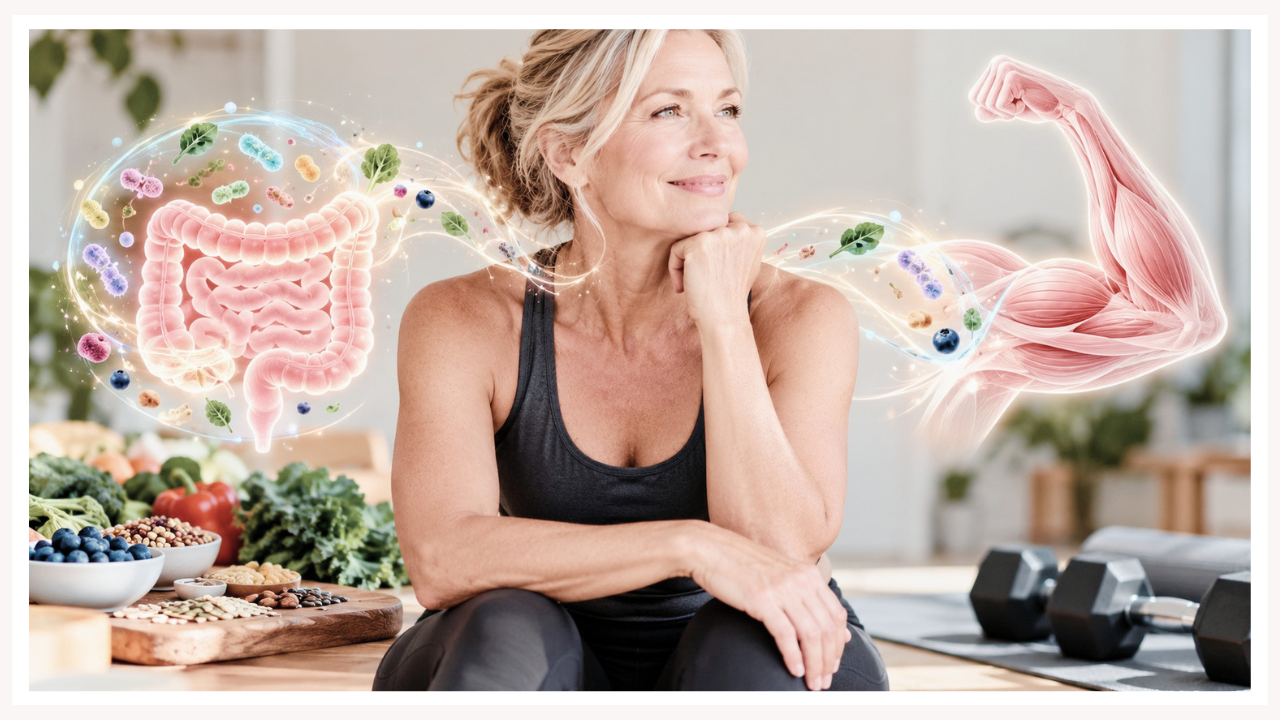
Scientists are investigating the gut–muscle axis, which describes the possible two-way relationship between our gut microbiome and skeletal muscles.
Our gut contains trillions of microorganisms that help break down components of food, produce useful compounds and interact with our immune and metabolic systems.
When these microorganisms ferment certain types of dietary fibre, they produce compounds called short-chain fatty acids.
These compounds are being studied for their potential influence on inflammation, energy metabolism and muscle function.
Researchers have also observed differences in the gut microbiomes of older adults with and without sarcopenia.
A systematic review published in Nutrients examined 20 studies involving more than 4,000 older adults and found associations between gut microbiome characteristics and measures of muscle health.
Some interventions targeting the microbiome showed improvements in muscle strength or physical function. Others didn't. And that's an important distinction.
We have evidence of a relationship, but we're still working out exactly how it operates and whether changing the microbiome directly can improve muscle health.
It's fascinating research, but we're not at the stage where anyone can confidently tell you that taking a particular probiotic will build muscle.
If only it were that easy.
Protein matters. But more isn't always better.
Now, before anyone decides I'm abandoning my protein obsession, don't panic. Protein remains enormously important, particularly for midlife women.
As we age, our muscles can become less responsive to the muscle-building effects of protein. This is often referred to as anabolic resistance. It's one reason I encourage women, particularly those who are strength training, to pay attention to how much protein they're consuming and how they're spreading it across their meals.
For active midlife women, a daily intake around 1.6–2.2 grams per kilogram of body weight can be an appropriate target, depending on individual needs, training and health circumstances.
But here's where we need a little perspective.
Eating more and more protein doesn't automatically mean building more and more muscle. There comes a point where additional protein offers diminishing returns, particularly if you're already consuming enough.
And protein doesn't operate in isolation.
Your muscles need a reason to grow. That's where progressive resistance training comes in.
They also need adequate energy, recovery and a varied diet that provides the nutrients required to support overall health.
So while protein deserves its place at the table, it doesn't need to take over the entire menu.
Don't forget to feed your gut
One thing I see quite frequently, particularly among women trying to lose weight, is a diet becoming increasingly focused on protein at the expense of everything else.
Eggs, chicken, yoghurt, protein shakes. Repeat.
Now, there's nothing wrong with those foods. They're useful sources of protein.
But what about the fibre?
What about the vegetables, legumes, wholegrains, fruit, nuts and seeds?
These foods provide different types of fibre and plant compounds that help support a diverse and healthy gut microbiome.
And given what we're learning about the possible relationship between our gut and muscle health, it makes sense to look at the bigger nutritional picture.
You don't need to start counting 30 different plants every week or turn every meal into a nutritional mathematics equation.
But adding more variety to your meals is a sensible place to begin.
A handful of berries with breakfast. Some chickpeas or lentils with lunch. A few different vegetables with dinner. Nuts, seeds and wholegrains where they fit.
Small additions, repeated consistently.
And if you're taking a GLP-1 medication and struggling with reduced appetite, this becomes particularly relevant.
When you're eating substantially less food, getting enough protein, fibre and other essential nutrients can require more planning.
It's one of the reasons I spend so much time encouraging women to look beyond the number on the scales.
Losing weight and looking after your long-term health aren't automatically the same thing.
The most important part? Keep lifting.
As interesting as the gut–muscle research is, we shouldn't lose sight of what we already know works.
Progressive resistance training is one of the most effective things we can do to improve muscle strength as we age. And you don't need to train like a competitive bodybuilder.
For most women, two or three well-structured strength sessions each week can provide an excellent foundation.
We're talking about movements that challenge the major muscle groups, with enough resistance to encourage adaptation and progression over time.
Squats, deadlifts, rows, presses and other exercises adapted to your abilities, experience and any physical limitations.
Walking, swimming, Pilates and other activities can all contribute to a healthy, active lifestyle. But they don't necessarily provide the same muscle-building stimulus as progressive resistance training.
And while we're looking after our muscles, we shouldn't forget about sleep, recovery and eating enough to support the work we're asking our bodies to do.
Your future self has a vested interest in this
One of the things I wish more women understood is that building muscle in midlife isn't simply about getting stronger in the gym.
It's about preserving your options.
Being able to travel, carry your own luggage, get up off the floor, enjoy long walks, play with grandchildren if that's part of your life, and remain physically capable for as many years as possible.
It's about giving yourself the best chance of maintaining independence as you age.
And while the scientists continue investigating the fascinating conversations happening between our gut microbes and our muscles, we already have a pretty good starting point.
Lift weights regularly. Eat enough quality protein. Include a wide variety of fibre-rich plant foods. Move throughout the day. Prioritise recovery.
None of it requires a cupboard full of supplements or a complicated wellness routine. Just a willingness to invest in the body you're going to be living in for a very long time.
And ladies, that's an investment worth making.
XO Jane
Your Midlife Wingwoman
References and further reading
-
ZOE (2026). How to build muscle and stay strong at any age, featuring Professor Claire Steves and Professor Tim Spector.
-
Barry, D. J., Wu, S. S. X. & Cooke, M. B. (2025). The Relationship Between Gut Microbiota, Muscle Mass and Physical Function in Older Individuals: A Systematic Review. Nutrients, 17(1), 81.
-
Is moderate resistance training adequate for older adults with sarcopenia? (2023). Systematic review and network meta-analysis of 50 randomised controlled trials.
-
Australian Government Department of Health, Disability and Ageing (2026). 24-hour Movement Guidelines for Adults and Older Adults.
DOWNLOAD YOUR FREE
MIDLIFE RESET GUIDE
Part pep talk, part power move—your midlife guide to ruling the chaos with grit, grace, and a side of snark.
I hate spam more than I hate bad hair days. Your info’s safe with me—I promise.