
The Supplement Trap Nobody Really Talks About - But They Should!
There’s a moment I keep seeing more and more often lately. It doesn’t start in a clinic or a textbook. It starts in group chats.
A message pops up from a friend. A bit of a warning, or something she’s just read, or something she’s been told by her GP that suddenly feels important enough to share.
That’s exactly what happened this week.
One of my girlfriends sent through a message about vitamin B supplements.
The short version was this: she’d come close to what’s considered vitamin B toxicity.
And that stopped the conversation in its tracks.
Because vitamin B is one of those things most people assume is completely harmless. It’s in energy supplements, multivitamins, stress blends, hair and skin formulas… it’s everywhere. It’s also marketed in a way that makes it feel almost optional to question it.
Just vitamins, right?
Except it’s not always that simple.
Some B vitamins, particularly when taken in high doses or stacked across multiple products, can build up in the body or create unwanted effects over time. Things like nerve symptoms, tingling, flushing, sleep disruption — depending on the type and dose.
And the part most people don’t realise is how easily this happens without intention.
A multivitamin here. A “hair and nails” supplement there. Something for energy on low days. Individually, none of it looks excessive. Together, it can quietly become more than your body actually needs.
That conversation led to everyone suddenly mentally scanning what’s sitting in their bathroom cabinet.
The bigger issue isn’t vitamin B. It’s how easily this happens.
I see this all the time, not just in private conversations but in online communities too.
Someone mentions they’re feeling tired, or flat, or not quite themselves, and within minutes there’s a flood of recommendations.
Magnesium for sleep.
B vitamins for energy.
Iron for fatigue.
Electrolytes for everything.
Something someone saw on Instagram that “changed everything”.
None of it is usually said with bad intent. In fact, it’s the opposite. People want to help. They want to share what worked for them.
But almost none of it comes with context.
No one knows what you’re already taking. No one knows your diet. No one knows your medication. No one knows whether that suggestion is adding to something you’re already getting elsewhere.
And that’s where things start to drift. In a slow layering of supplements that may overlap, duplicate, or simply not be necessary in the first place.
The uncomfortable truth about supplements
There’s a widespread assumption that supplements are harmless because they’re sold over the counter.
But that’s not the same as being irrelevant to your physiology.
Supplements are biologically active. Some interact with each other. Some affect absorption of nutrients. Some can build up in the body. Some are only useful in very specific circumstances.
And the biggest issue isn’t usually one supplement on its own.
It’s stacking.
Stacking similar products without realising it. Stacking nutrients across multiple formulas. Stacking “just in case” solutions until it becomes hard to know what’s actually doing anything.
And sometimes, what starts as an attempt to feel better quietly turns into feeling more confused — or even worse, not better at all.
Why this gets even more complicated in midlife
Midlife is often when women start paying closer attention to their health.
Energy changes. Sleep shifts. Recovery slows down. Hormones fluctuate. Weight behaves differently than it used to.
So it makes sense that people start looking for support.
The issue is that the supplement industry is very good at stepping into that gap and offering certainty. Something for balance. Something for hormones. Something for metabolism. Something for stress. Something for gut health.
The language is comforting. The packaging is convincing. And it creates the impression that more support is always better.
But physiology doesn’t really work in stacks of “support”.
It works in systems, inputs, and balance — not product layering.
Where GLP-1 medications change the picture
GLP-1 medications like Ozempic, Wegovy, Mounjaro, Zepbound, Retatutride and others add another layer to this conversation.
These medications work by reducing appetite and slowing gastric emptying. Food feels less urgent. Fullness comes earlier. Overall intake often drops without conscious restriction.
That’s part of how they work.
But it also means nutritional intake can quietly reduce over time.
Protein intake can fall simply because smaller meals contain less of it. Fibre can drop due to reduced food volume. Fluid intake can also decrease because thirst and appetite cues are linked more than most people realise.
And over time, that combination can show up as fatigue, constipation, reduced strength, low energy, or in some cases hair shedding during weight loss phases, because input has changed.
This is where supplements are often brought in — sometimes appropriately, sometimes reactively, and sometimes in ways that add more complexity than clarity.
When “more” stops helping
One of the biggest patterns I see is overcorrection.
Something feels off, so more support gets added. Then more. Then something else just in case.
But more doesn’t always equal better.
Sometimes it just means overlap. Or duplication. Or unnecessary expense. Or side effects that don’t get linked back to what’s been added.
And occasionally, it means something like the vitamin B situation — where well-intentioned supplementation quietly crosses into too much without anyone realising.
A more useful way to think about supplements
Instead of starting with “what should I take?”, it’s often more helpful to start with a different question entirely:
Is there actually a gap here?
A gap in diet. A gap in intake. A gap confirmed by symptoms or blood work. A clear physiological reason for something to be added.
If the answer isn’t clear, it usually doesn’t need to be added yet.
Observation is often more useful than accumulation.
A small challenge before you go
Go ahead, have a look in your pantry or bathroom cabinet.
How many half-used bottles are sitting there? How many are still sealed but long forgotten? How many expiry dates are from years (or even decades) ago?
We’ve all fallen into the trap of thinking more is better. More support, more balance, more “just in case”.
But more often than not, that’s not what the body actually needs.
And if nothing else, I hope this is a small nudge towards less guesswork, less unnecessary expense, and fewer side effects from things that were never really needed in the first place.
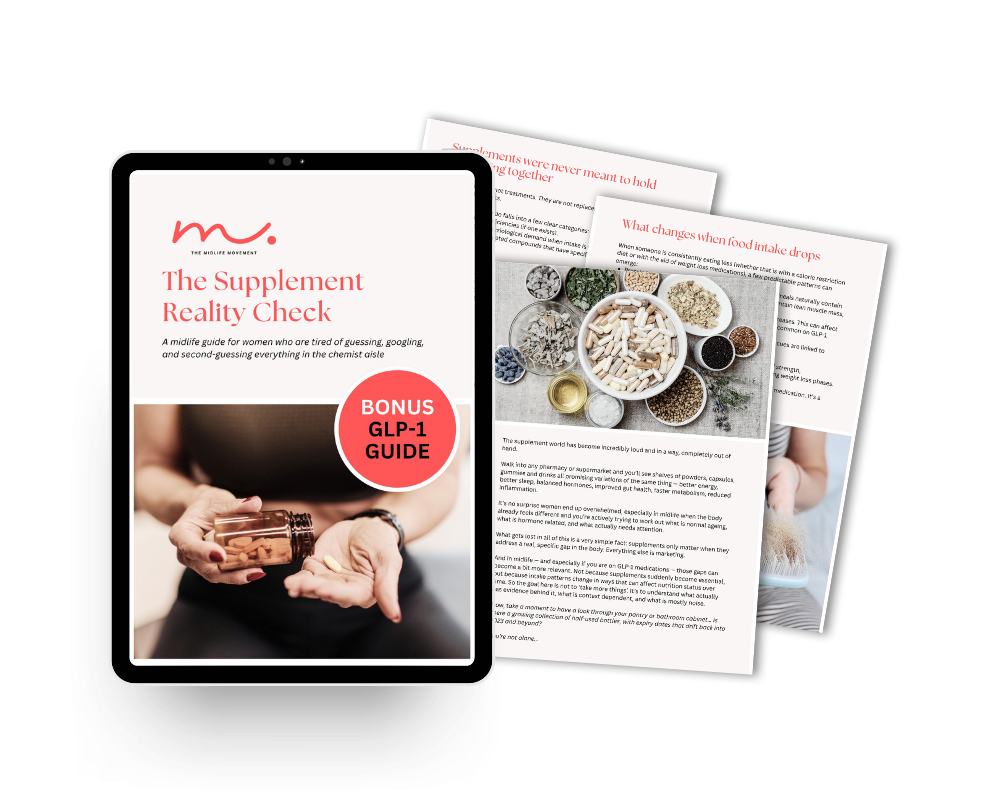
If you want to go deeper
I’ve put together a free guide that breaks all of this down properly — what supplements actually do, where risks show up, what changes in midlife, and how GLP-1 medications fit into the picture without the noise or hype.
👉 Download The Supplement Reality Check here
It’s designed to give you clarity, not more things to add to your routine.
Just better understanding of what’s actually worth your attention — and what isn’t.
XO Jane
DOWNLOAD YOUR FREE
MIDLIFE RESET GUIDE
Part pep talk, part power move—your midlife guide to ruling the chaos with grit, grace, and a side of snark.
I hate spam more than I hate bad hair days. Your info’s safe with me—I promise.